
Jaguar I-Pace Boot Dimensions in cm
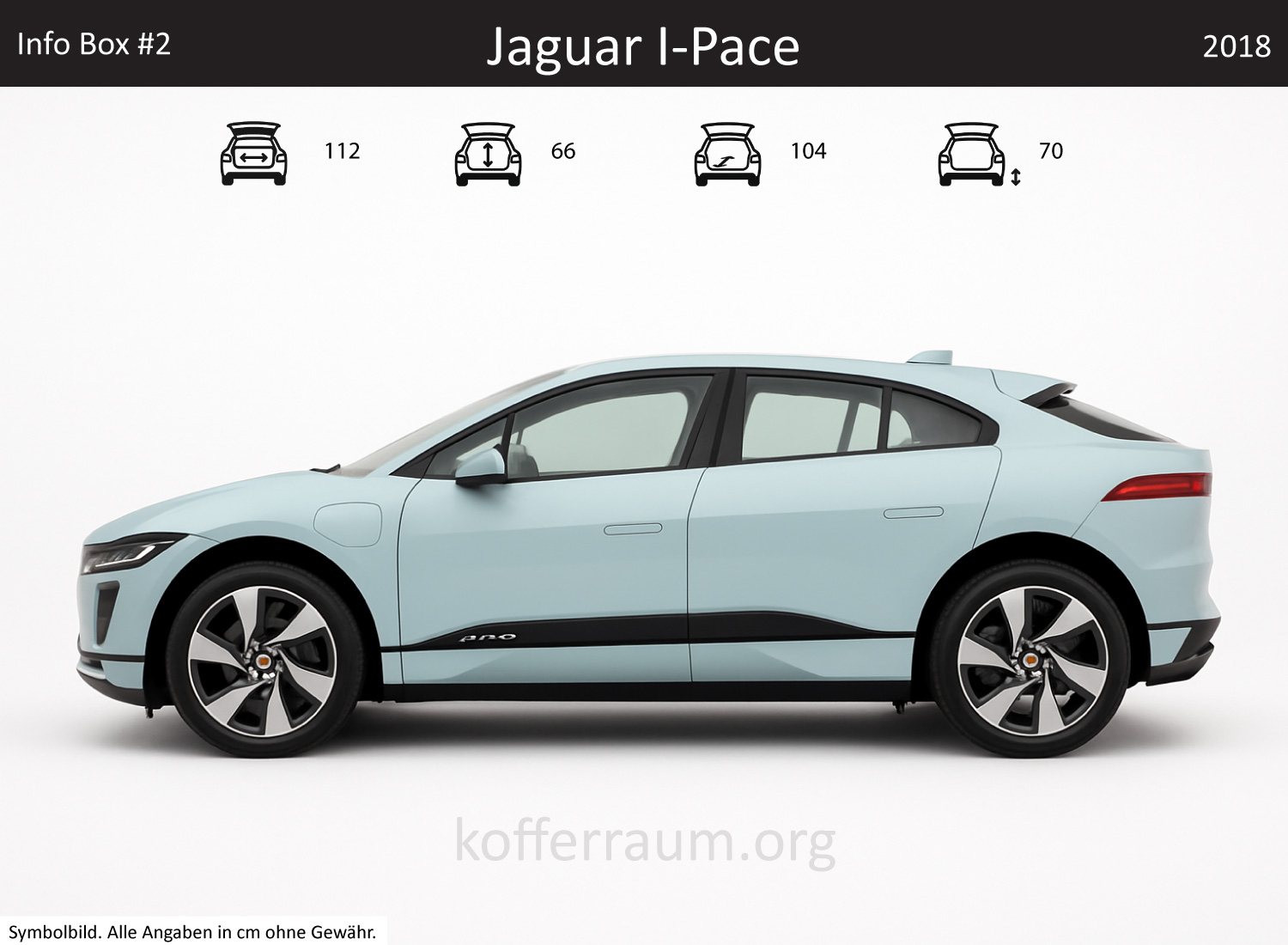
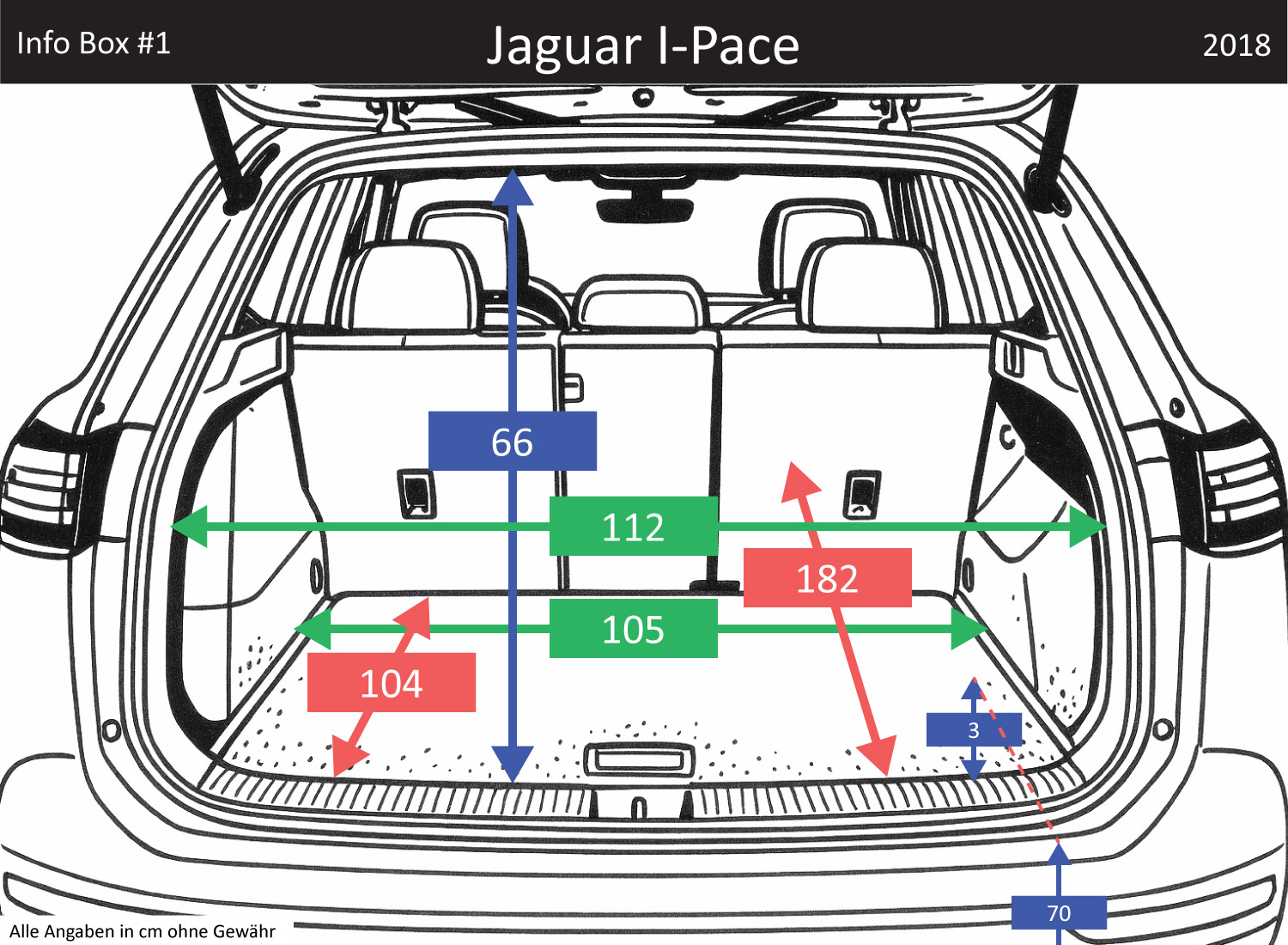
Model information
The Jaguar I-Pace is a fully electric SUV that first went on sale in 2018. It combines sporty performance with an elegant design and offers a range of up to 470 km (WLTP). The I-Pace is equipped with all-wheel drive and accelerates from 0 to 100 km/h in just 4.8 seconds. The interior is of high quality and features cutting-edge technology, including an infotainment system with a touchscreen. The I-Pace is an example of Jaguar’s commitment to electrification and combines sustainability with luxury.
Variants in the same line-up
The Jaguar I-Pace is offered exclusively as an SUV. There are no other variants such as saloons, convertibles or estates within this model line-up. This sets the I-Pace apart from other Jaguar models that are available in different body styles. Buyers should be aware that the I-Pace occupies a unique position in Jaguar’s portfolio, as it is the manufacturer’s first fully electric vehicle.
Model year differences
Since its introduction in 2018, the Jaguar I-Pace has been continually updated. The major changes affecting the exterior dimensions and boot capacity occurred in model years 2020 and 2021. These updates included improvements in software and battery technology that increased the vehicle’s efficiency and range, but did not result in any significant changes to the physical dimensions or boot capacity.
Direct competitors
In the same price class and size as the Jaguar I-Pace, models such as the Audi e-tron and the Mercedes-Benz EQC can be found. The Audi e-tron offers a boot capacity of 660 litres, making it only marginally larger than the I-Pace. The Mercedes-Benz EQC, on the other hand, has a boot capacity of 500 litres, which makes it smaller in comparison to the I-Pace. These differences can be decisive for buyers who place value on storage space.
More affordable alternatives
For buyers seeking more affordable alternatives with similar boot dimensions, models such as the Kia e-Niro and the Hyundai Kona Electric should be considered. The Kia e-Niro offers a boot capacity of 451 litres, while the Hyundai Kona Electric has a capacity of 332 litres. Both models are cheaper than the I-Pace, but offer less storage space, which could be a disadvantage for some buyers.
All information on this site is provided without warranty, and no liability is accepted for its accuracy or completeness.