
Average Hatchback Boot Dimensions in cm
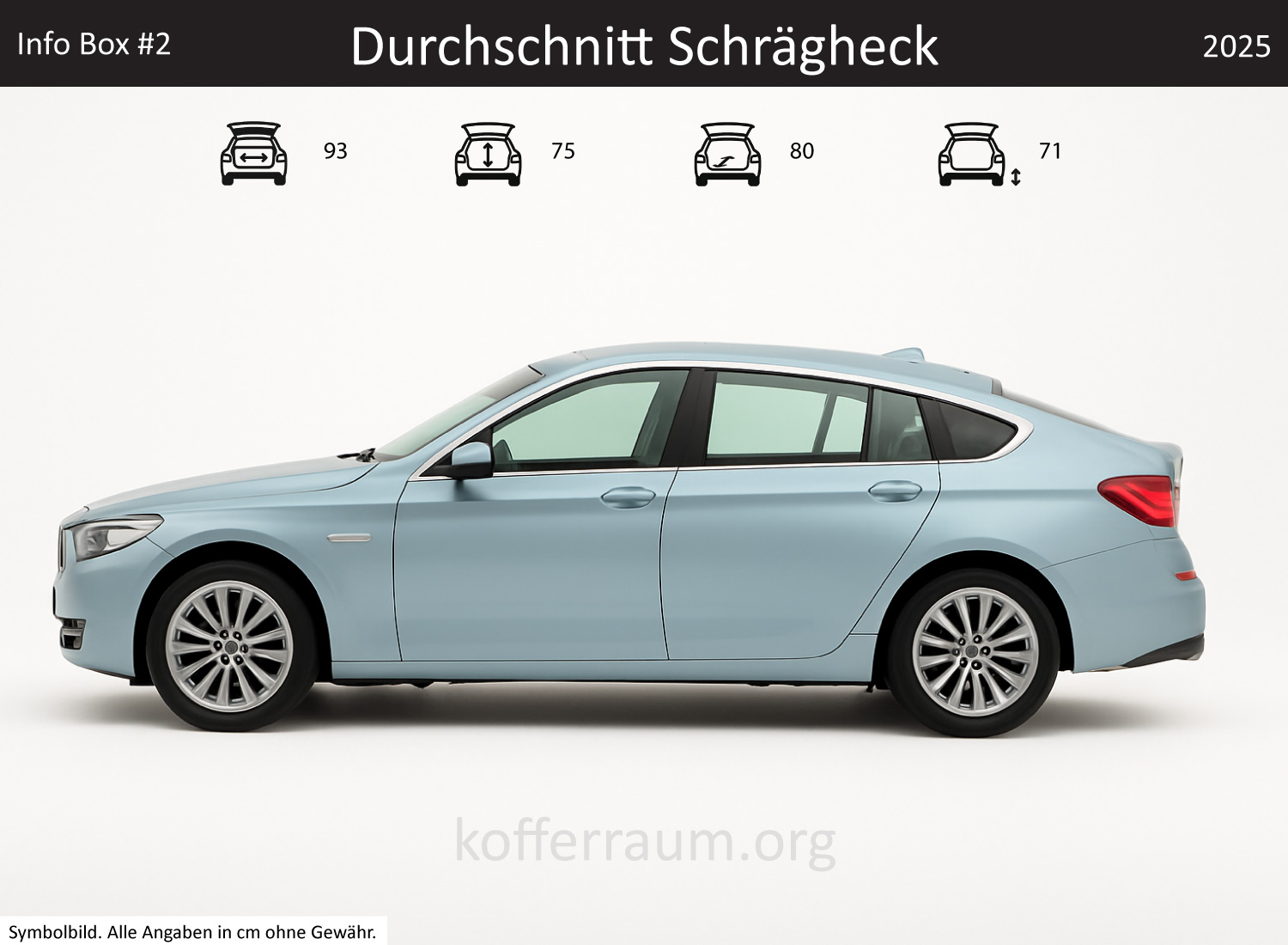
Vehicle Type
A hatchback is a body style in which the tailgate extends from the roof to the bumper and provides direct access to the boot space. Typically it is a compact or subcompact car with a steep rear window and a large, upward-opening tailgate. The access is practical for everyday use: shopping, luggage or medium-sized items can be loaded more easily through the rear opening than in a traditional saloon with a boot lid. Hatchback models come in different lengths and glazing options, but are usually constrained to compact exterior dimensions and good interior practicality.
Variants
Within the hatchback family there are variants whose boot dimensions differ markedly. Three- and five-door versions usually differ in usability: the five-door models frequently offer more practical access for rear-seat passengers and slightly different interior layouts, though not always a significantly larger volume. Additionally, there are sportier liftback interpretations, which due to more steeply angled rear sections reduce the usable interior height. Crossover or tall-roof variants based on hatchbacks (city SUVs) come with a higher loading lip and often larger loading capacity, but also with a higher loading floor. Estate versions (estate/wagon) or hatchbacks with an extended wheelbase usually offer the largest boot space in the same class; they are not formally part of the classic hatchback base variant, but they are closely related. Manufacturer-specific special models with extended wheelbases or modules for transport purposes can also yield markedly different dimensions.
Boot space
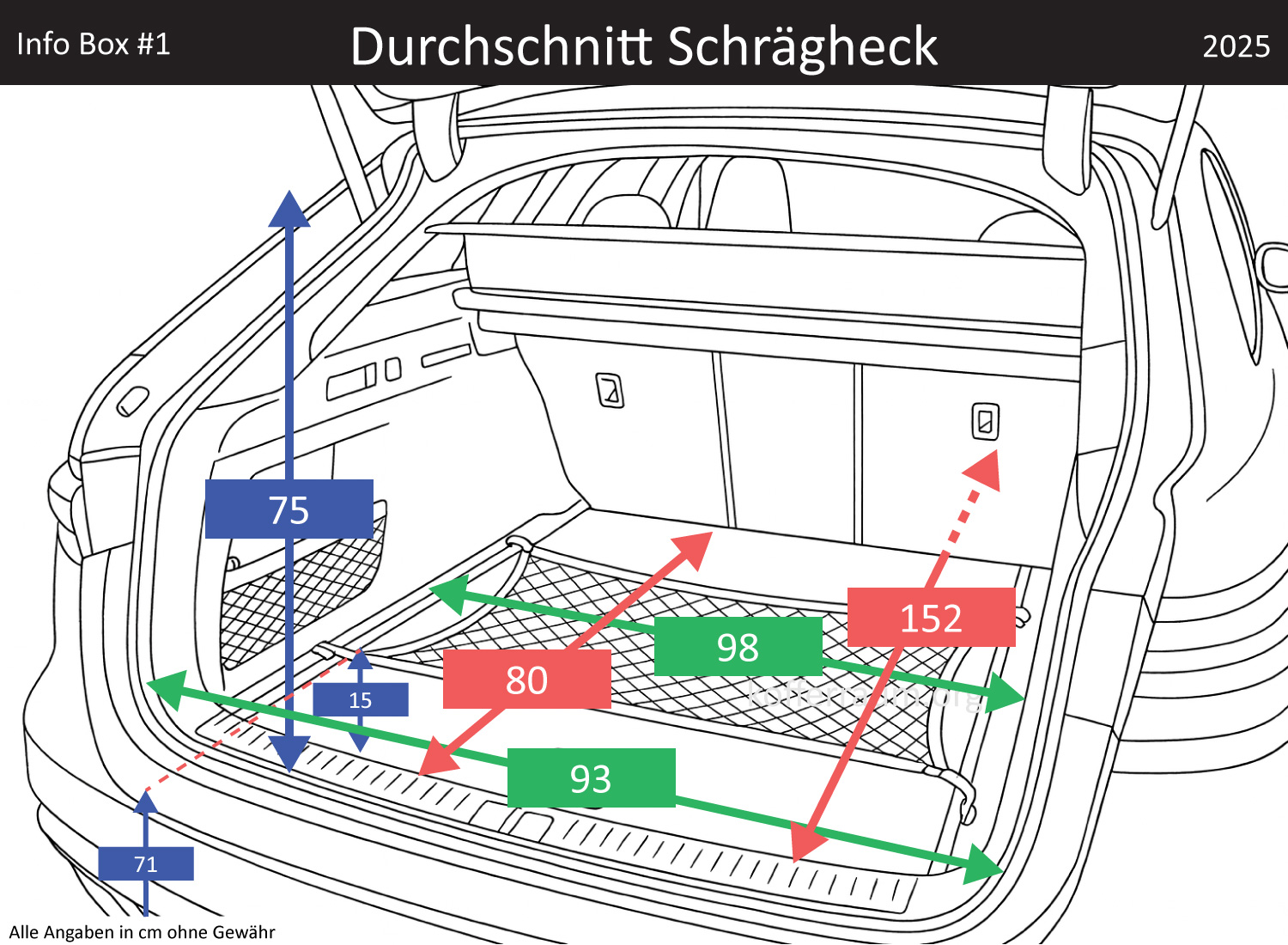
The boot space of an average hatchback is designed for flexible use of space: base volume with the rear seat in the upright position is typically around 250–350 litres for small cars, and around 350–450 litres for compact cars. With the rear seats folded, the volume rises significantly and in many cases reaches 1,000 litres or more; exact values vary depending on vehicle length and fitment. Typical features include a removable or sliding boot cover (parcel shelf), a split-folding or 60/40 or 40/20/40 rear seat, a loading area that is as flat as possible after folding the rear seats, and additional storage beneath the loading floor. Restrictions arise from wheel arches, a steep roofline or a high loading lip, which limit the width and height of the usable loading opening. Many modern hatchbacks offer galvanised mounting points, tie-down points, optional loading-floor variants and a low loading lip for easier loading and unloading. For long items there is often a through-loading hatch or asymmetrically folding rear seats; completely flat loading floors are not standard on all models.
History
The basic idea of the combined tailgate and the variable load space gradually gained traction from the mid-20th century as manufacturers began to optimise compact vehicles for everyday use. Since the 1960s/1970s hatchback concepts spread, improving space utilisation and practicality in smaller exterior dimensions. Over time, standards for interior flexibility grew: standard folding mechanisms, split-fold rear seats and upscale options such as adjustable loading floors or electric tailgates were introduced. In recent decades additional safety and comfort features have been integrated (e.g., tie-down points, modular flooring solutions, sensor-controlled tailgates), while the range of variants expanded toward crossover/high-riding options. Overall, the concept has evolved from a simple loading space to a multifunctional everyday storage solution.
Classics
Among the best-known representatives and classic hatchback models over the years have been several best-sellers in their segments. Examples include compact or mid-size models that were influential in many markets: the VW Golf (in its hatchback variants), various Renault models, the Ford Fiesta and Focus in their respective generations, as well as models from Opel, Peugeot and Toyota with widely spread hatchback variants. These cars stand as exemplars of the mix of everyday practicality, versatile loading areas and high market volume, making them often regarded as benchmarks for hatchback design.
More affordable models
In the lower price segment, numerous compact hatchbacks are available that offer good value for money with simple equipment and robust loading concepts. Typical representatives in the budget-friendly range are city cars from manufacturers that offer affordable base models, as well as brands focusing on entry-level vehicles. Examples include affordable variants of established models and brands that explicitly target low-cost mobility. In the used market, older hatchbacks are plentiful and often inexpensive, making them attractive to budget-conscious buyers. When buying, buyers should check not only the base boot space but also equipment details such as the split rear seat, presence of a variable loading floor and the condition of seals and hinges.
All information on this site is provided without warranty, and no liability is accepted for its accuracy or completeness.