
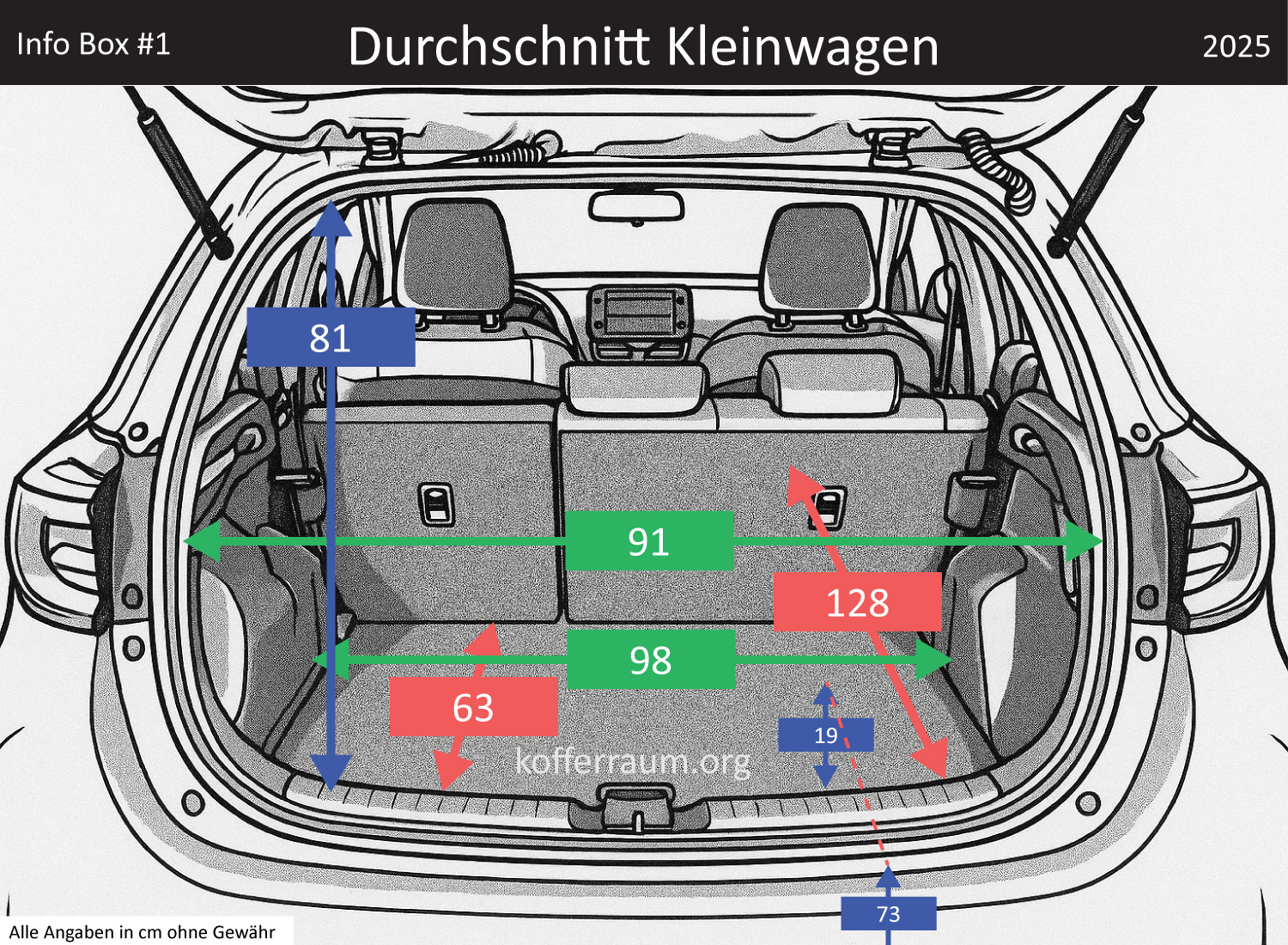
Average City car Boot Dimensions in cm

Vehicle Type
The term ‘city car’ in Europe usually refers to compact, affordable cars for urban and everyday use. City cars are designed for efficient use of space, low fuel consumption and easy manoeuvrability. They typically accommodate four to five people and have a compact overall length, which makes urban parking and manoeuvrability easier. The focus is on practical design: short overhangs, a high proportion of interior space and simple controls. For many buyers, alongside purchase and running costs, the everyday practicality of the boot space is also an important criterion.
Variants
Within the city car segment there are several body styles that can differ significantly in boot dimensions. The most common form is the five-door hatchback; alongside it there are three-door variants, notchback variants (small saloons), estate variants (compact estates) as well as small SUVs/crossovers and occasional hatchback designs. Estate cars and some saloons typically offer a larger, more elongated boot space than a typical hatchback. Crossover variants can differ with higher load lips and often more load height. Electric derivatives and models on modular platforms can also show different load volumes, for example due to underfloor batteries or additional storage spaces.
Boot capacity
The boot of an average city car is designed for everyday practicality: it typically holds the contents of several shopping bags or two to three mid-sized suitcases. In classic city car hatchbacks, usable volume is often in the low to mid range; as a rough guide ranges have been cited, while saloons and estates offer larger or more variable capacities. Characteristic features include a limited footprint due to the wheel arches, sometimes a high load lip and a loading area that is not always perfectly rectangular. Practical features include folding rear seats (often 60:40 or asymmetrically split), fold-flat loading floors, trays and tie-down points. Some models have additional storage under the boot floor or a spare tyre; in others a tyre repair kit replaces the spare tyre to gain more volume. For bulky transports, folding rear seats or optional roof racks and tow bars are common solutions.
History
The development of the boot in the city car segment follows general vehicle development: Early city cars often had very small, separate luggage compartments or limited loading space, because interior space took priority. With the spread of the hatchback and the practical five-door from the 1970s and 1980s, the importance of a flexible loading area grew. In recent decades, modular platforms and intelligent interior concepts have further improved space utilisation. Safety requirements, crash tests and emission/crash components influence the shape of the boot as much as comfort features (removable rear seats, flatter loading floors). At the same time, cost pressures and efficiency considerations have sometimes led to the elimination of bulky spare wheels in favour of tyre repair kits and extra storage space.
Classics
Among the well-known models that shape the city car segment are vehicles such as the VW Polo, Ford Fiesta, Opel Corsa, Renault Clio, Peugeot 208, Toyota Yaris and Fiat 500. These models are often benchmarks when comparing interior space and boot capacity, as they have long been on the market and have been revised across multiple generations. Boot sizes and practical usability vary between generations and trims, but all the listed models exemplify the balance between compactness and everyday practicality that city car buyers expect.
Budget-friendly models
In the lower price segment there are models such as the Dacia Sandero, various entry-level variants from Hyundai (e.g., i10), Kia (e.g., Picanto), Fiat Panda and smaller Suzuki models. These vehicles often offer good value for money and, in some cases, surprisingly generous cargo capacity relative to the purchase price. Limitations may lie in material quality, comfort equipment or less upmarket refinement options, while the basic practicality of the boot — easy folding rear seats, tie-down points, usable floor area — is usually preserved. For price-conscious buyers, the combination of usable boot space and low purchase and running costs is often decisive.
All information on this site is provided without warranty, and no liability is accepted for its accuracy or completeness.