
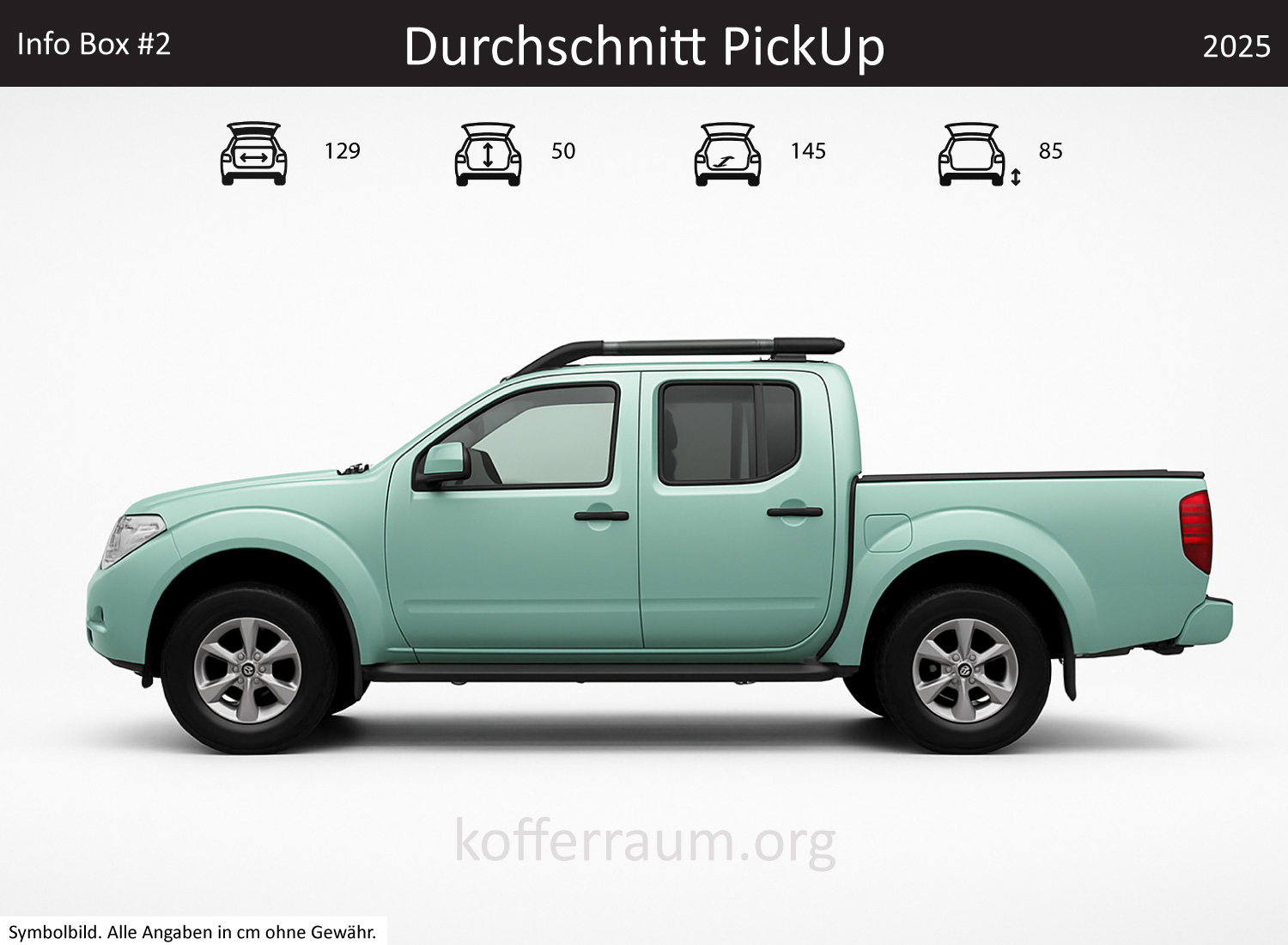
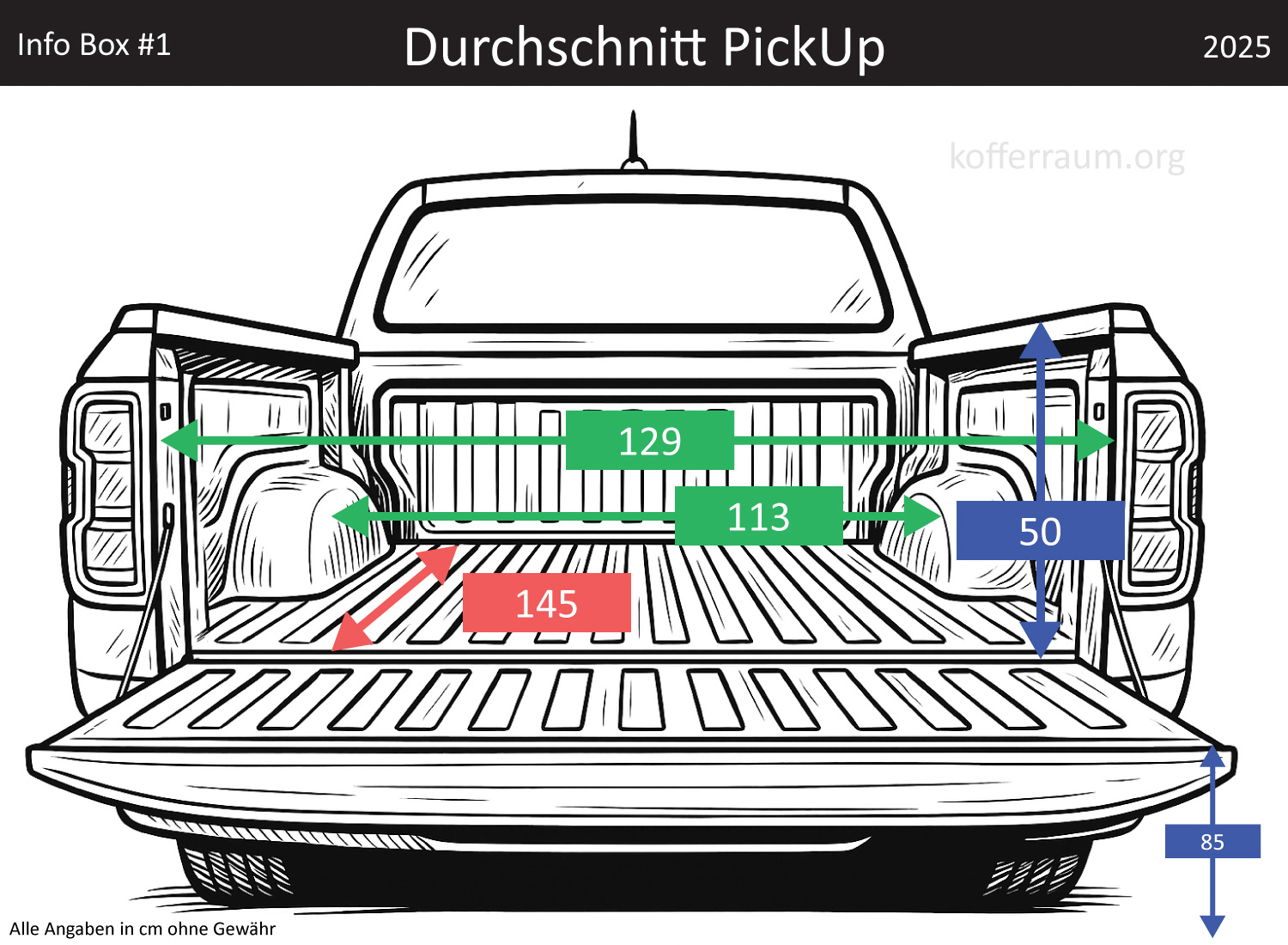
Average Pickup Boot Dimensions in cm
Vehicle Type
A pickup is a passenger car/utility vehicle with an open, rear-mounted cargo bed (often also called a loading bed or cargo bed) and a driver’s cab that is separated from this cargo bed. In many languages the cargo bed is colloquially referred to as the ‘boot’, although technically it is more correctly described as a cargo bed or loading area. Pick-ups are generally designed for a combination of transport tasks and carrying passengers: they offer a robust vehicle architecture, usually rear‑wheel drive or four‑wheel drive, high ground clearance and a permissible payload that allows transporting goods, tools or leisure equipment. Applications range from everyday trades and agriculture and construction to leisure use and premium comfort-focused variants.
Variants
Pick-ups are available in several body styles that directly affect the dimensions and payload capacity of the cargo bed. Common variants are Single Cab (only driver and front passenger seats, longer cargo bed), Extended Cab (short rear seat or occasional seats, mid-length cargo bed) and Double Cab / Crew Cab (four full doors and room for several passengers, shorter cargo bed). In addition there are differences in bed length (Short Bed, Standard Bed, Long Bed), bed width (depending on wheel arches and axle components) and specialised bodies such as flatbeds, tipper bodies or enclosed bodies/hardtops. Models with four‑wheel drive and differential locks differ in wheelbase and ground clearance, which in turn affects the usable cargo bed.
Load bed volume
With pickups, load volume is less often specified as ‘boot volume in litres’; manufacturers tend to cite bed length, width between wheel arches and the permissible payload (payload). Typical dimensions of light to mid‑size pickups: bed lengths of about 1.2 to 2.2 metres, usable widths between 1.2 and 1.8 metres and load heights around 0.4 to 0.6 metres. This yields, depending on configuration, a calculable load volume of roughly 1 to 3 cubic metres; however the payload is more important, which for light pickups typically lies between about 500 kg and 1,200 kg. Typical features of the cargo bed include robust floor construction (steel, aluminium or plastic bed liner), tie-down points, optional bed liners, rollable or foldable covers (tonneau, hardtop), a retractable tailgate and adapters for toolboxes and shelving systems. Pick-ups allow the transport of long, bulky goods (e.g. building materials, ladders), towing of trailers and flexible conversion to specialist bodies.
History
The development of the pickup is a gradual adaptation to commercial needs and consumer preferences. From simple, open commercial vehicles of the early 20th century, increasingly mass‑produced pickups emerged that served trades and rural use over the course of the century. In the second half of the century comfort and safety features were added, cab variants became more varied and the vehicles shifted from pure utilitarian workhorses toward everyday and leisure use. Since the 1990s/2000s, demand for crew cabs and higher‑quality interior trim has grown; modern pickups offer driver assistance systems, comfort features and engine options ranging from economical diesel units to powerful petrol engines. Recently, electrification in the form of battery‑electric pickups and hybrid solutions has been observed; at the same time, rugged, simple variants remain important for trades and industry.
Classics
Among the typical, internationally known representatives are various manufacturers and model lines that have shaped the pickup class over many years. Examples include the Ford F-Series (especially in North America), Chevrolet/GM models such as Silverado, the Toyota Hilux, Nissan Navara/Frontier, Mitsubishi L200 and RAM/Dodge models. In different markets there are also locally popular models or derivatives of established platforms. These classics cover a broad spectrum: from rugged work pickups to large‑volume US full‑size pickups with high towing capacity.
More affordable models
More affordable pickups are found mainly in two categories: compact small/light-Pickup models in regional markets and older used examples from larger ranges. In many markets compact models from Latin America and Asia are designed to keep costs down; manufacturers also offer base variants (Single Cab, basic specification) as affordable workhorses. In the used market, older Toyota Hilux, Mitsubishi L200, Nissan Navara or Ford Ranger are often cheaper than new full‑size pickups; regionally there are also marque models such as Fiat Strada/Small Pickup derivatives or Volkswagen Saveiro, aimed at budget-conscious buyers. Overall, smaller and simpler trim levels as well as used vehicles are the most common routes to a cheaper pickup.
All information on this site is provided without warranty, and no liability is accepted for its accuracy or completeness.