
Average Van Boot Dimensions in cm
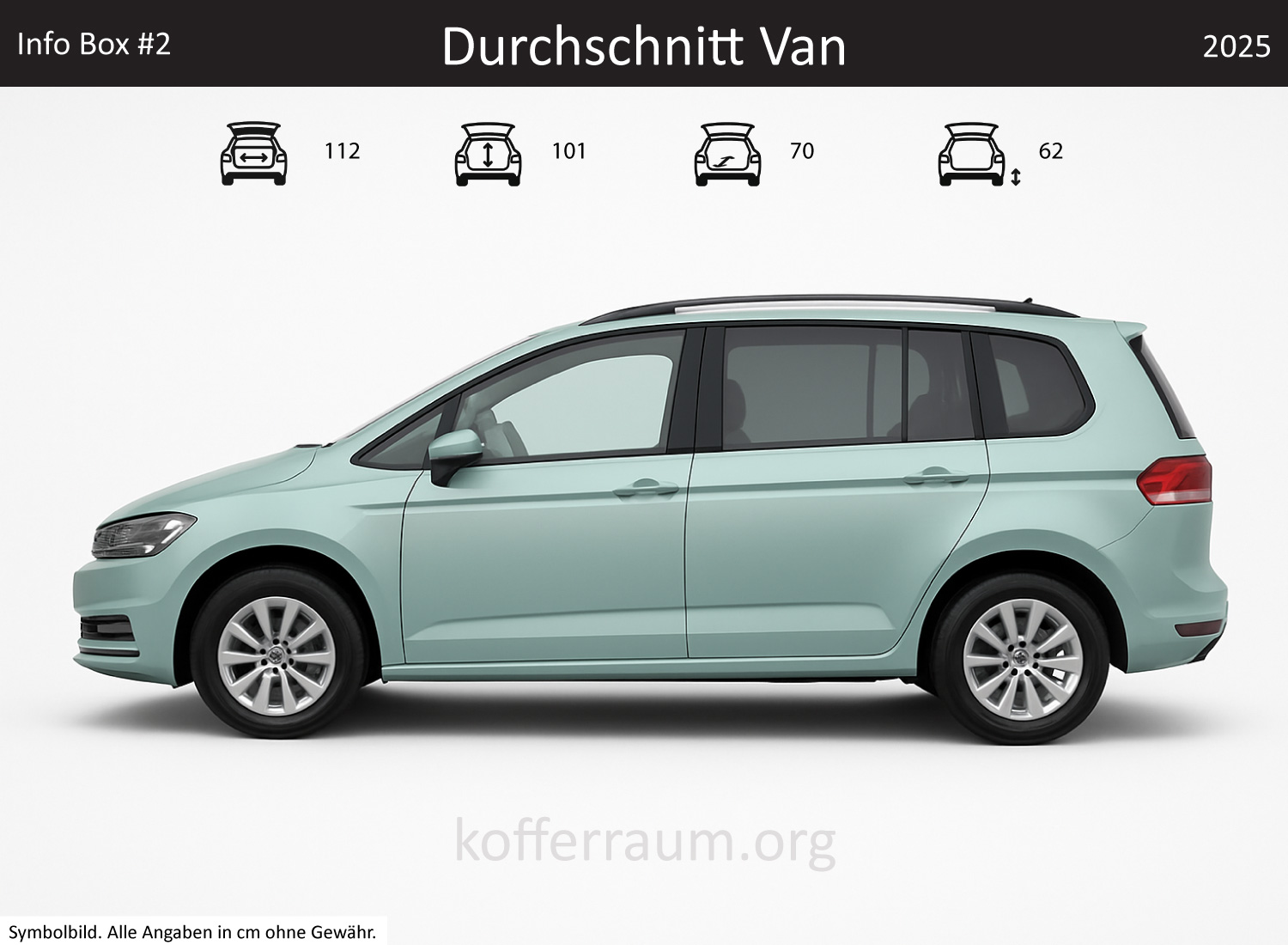

Vehicle Type
The van (in German-speaking regions often referred to as a transporter, panel van or box van) is a light commercial vehicle type that sits between a passenger car and a heavy goods vehicle. It combines a higher payload capacity with comparatively low purchase and running costs compared with heavy commercial vehicles. Vans exist both as pure transporters with a closed load area and as combi variants with several rows of seats for passenger transport. Characteristic features include a high roofline, configurable interior layouts, large side sliding doors and double doors or a tailgate for easy access to the load area.
Variants
Vans come in several body styles that differ considerably in load space dimensions: compact or city vans (smaller external dimensions, lower load volume), mid-size vans with a standard wheelbase, extended bodies with a long wheelbase and high-roof versions, and large-volume box vans on truck chassis. Additional variants include conversion versions for passenger transport (Multivan/Combi), chassis cabs with an open loading area for bespoke bodies, as well as refrigerated or box vans with special insulation. Electric variants and four-wheel-drive models alter weight and payload without changing the basic principle of variant development.
Load volume
The load volume of an average van is geared toward volume and practicality: clear, rectangular base shapes, flat loading floors and low loading edges make loading easier. Typical usable volumes roughly range from about 2–4 m³ in small vans, 5–9 m³ in mid-size models, up to 9–17 m³ or more in large high-roof long-wheelbase variants; concrete values vary by manufacturer and wheelbase. Load floor lengths commonly lie between about 1.5 m (compact van) and over 3 m (large long-wheelbase), load heights between about 1.2 m and just under 2 m. Built-in elements such as tie-down points, bulkheads, cargo rails, anti-slip coating and galvanised cargo floor options are often standard or available as options. Limitations arise from wheel arches, wheelbase geometry and any interior panelling. For bulky goods many vans offer a through-loading function by folding down or removing the front passenger seat; sliding doors on one or both sides and widely opening rear doors are standard for quick access.
History
The development of the van is an ongoing adaptation to transport needs. Early light commercial vehicles after World War II laid the groundwork; in the 1950s and 1960s the first mass-produced box vans emerged. From the 1980s/90s comfort, safety and modularity were increasingly emphasised: multi-purpose variants with seating rows for passenger transport as well as improved driver assistance systems appeared. In the last two decades stricter emission standards, higher comfort requirements and electrification have led to new propulsion forms (diesel, petrol, increasingly electric), integrated assistance systems and more flexible interior concepts. Alongside this, the range broadened: from small urban delivery vans to large logistics carriers with substantial volume and high payload.
Classics
As representative models that are widespread in many countries and have helped shape the van, series such as the Mercedes Sprinter, Ford Transit (including Transit Custom/Connect in variant sizes), the Volkswagen Transporter/Caddy and larger sister models such as the VW Crafter are typical. In the field of large panel vans, Fiat Ducato, Peugeot Boxer and Citroën Jumper are also common. These models stand for the breadth from small light delivery vans to high-volume transporters and have generated many variants over long product cycles.
More affordable models
Cheaper entry-level options are especially found in the compact van segment: Renault Kangoo, Citroën Berlingo, Peugeot Partner or older small vans such as the Fiat Doblo are often cited as cheaper alternatives. In the area of larger vans, manufacturers such as Fiat with the Ducato or its PSA siblings (Boxer/Jumper) frequently offer cost-efficient solutions compared with premium brands. Cheaper models typically have lower purchase, parts and maintenance costs, but may differ in equipment, comfort or resale value compared with pricier rivals. When buying used, it’s worth checking the condition of the body, load floor, corrosion protection and documented servicing.
All information on this site is provided without warranty, and no liability is accepted for its accuracy or completeness.