
Average Compact SUV Boot Dimensions in cm
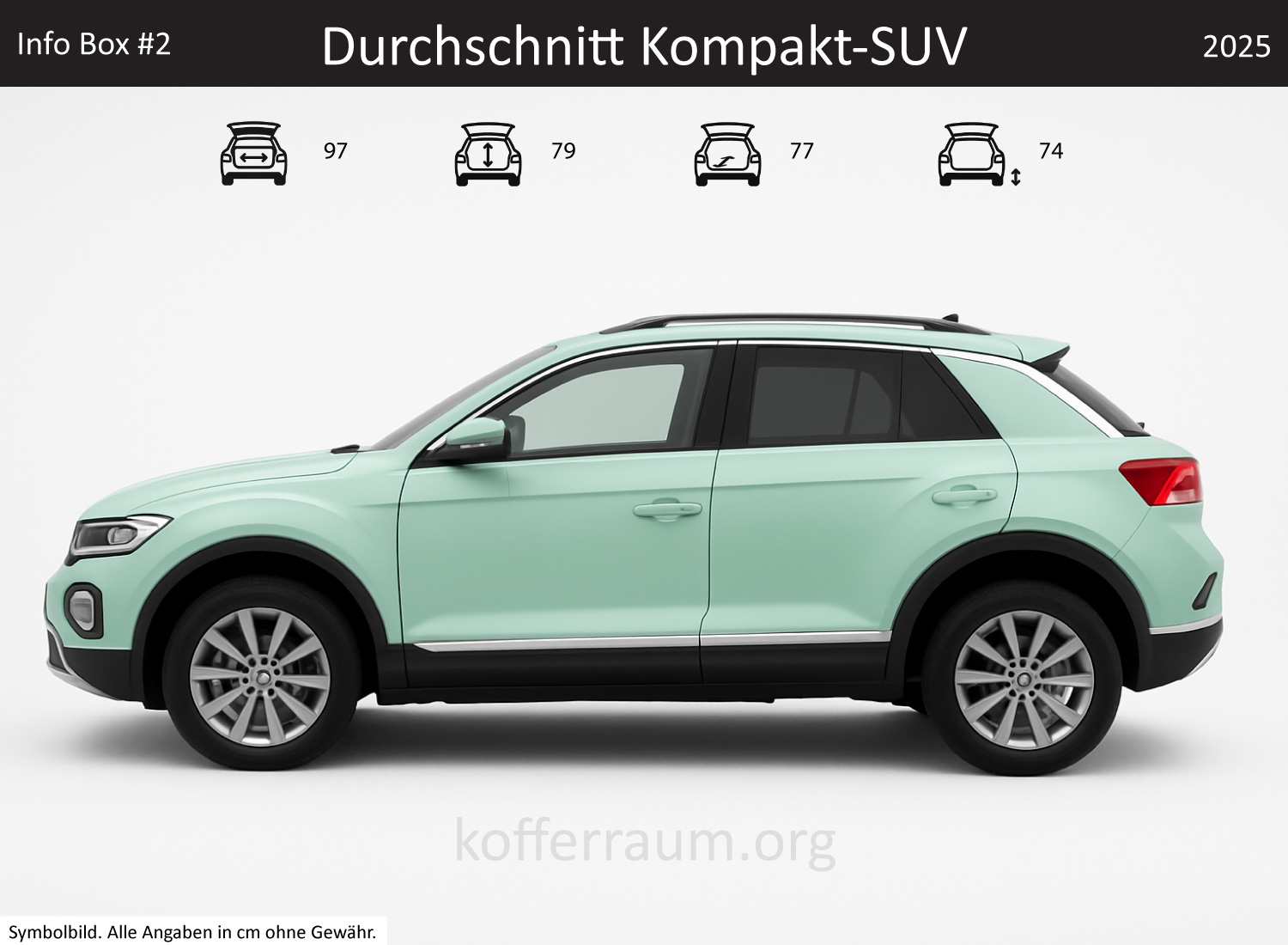
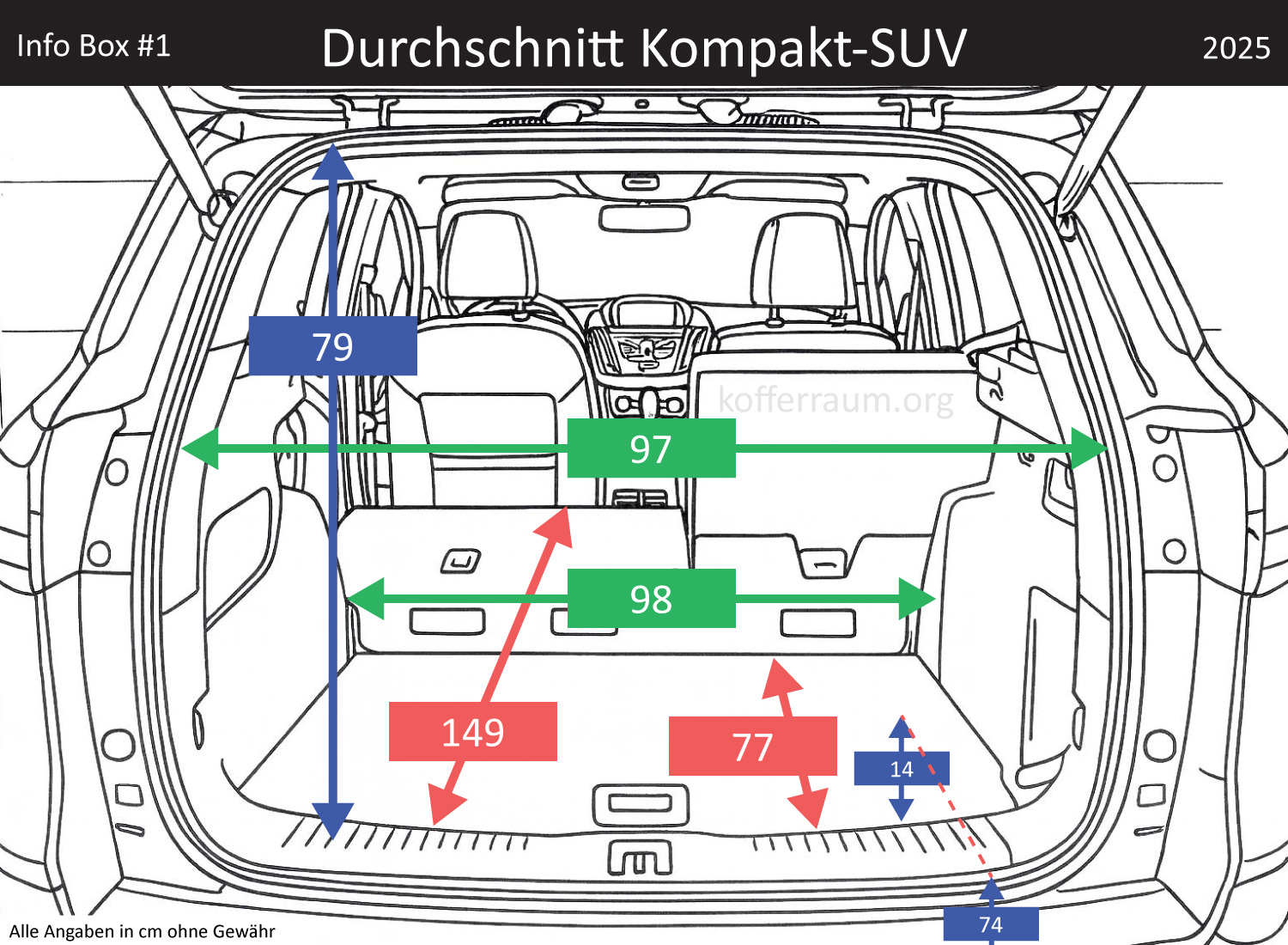
Vehicle Type
A compact SUV is a C-segment passenger car that combines the raised driving position and rugged look of an off-roader with the everyday practicality of a compact car. Characteristic features are a higher ride height, a relatively compact overall length (compared with mid-size SUVs), usually a five-seat interior configuration and a tailgate instead of a boot lid. Compact SUVs are frequently used as practical family vehicles: they offer good visibility in traffic, variable cargo space and often four-wheel drive or semi-automatic driver-assistance options, while remaining comparatively manageable for city driving and parking.
Variants
Within the type there are variants with markedly different boot dimensions. Coupé SUVs with a flatter roofline reduce the interior height and thus the usable cargo volume at the rear. Plug-in hybrid models often carry additional batteries in the underfloor or rear area, which can reduce usable volume compared with petrol- or diesel-powered versions. Some manufacturers offer extended wheelbase variants (long wheelbase), which improve rear-seat comfort and thereby often increase cargo volume. In addition, equipment variants differ by standard spare wheels, audio systems or boot-floor features that affect practical usable volume.
Boot capacity
The boot of an average compact SUV is designed for versatility: in daily use it offers enough space for groceries, a pram or a weekend trip; with the rear seats folded down a generously sized loading area for the class is created. Typical features include a fold-down rear seat (often 60/40 or 40/20/40 split), a removable or height-adjustable loading floor panel, a removable parcel shelf and underfloor storage compartments for tools or a warning triangle. The loading opening is usually wide, the loading lip often a little higher – this makes it easier to slide heavy loads in, but can hinder loading of heavier items.
As a rule of thumb: with the rear seats in their upright position, compact SUVs typically offer boot space in the several hundred litres range; common figures in many models lie between around 350 and 600 litres. With the rear seats fully folded, volumes can often range from about 1,100 to 1,600 litres – large deviations up or down are possible, depending on the vehicle shape and battery pack. Practical details such as tie-down points, a 12‑V socket, net partitions or foldable hooks increase usefulness; some models also offer a low loading lip or electronically opening/closing tailgate as a comfort feature.
History
The development of the compact SUV has been a benchmark for the evolution of the automotive market: from the idea of the off-roader, increasingly compact, road-going crossovers have emerged since the 1990s. Early pioneers used simple boxy shapes and offered limited comfort; with rising demand the focus shifted to ride comfort, interior flexibility and fuel efficiency. Design and packaging were refined, platforms more modular – thereby improving boot space, rear-seat flexibility and safety equipment. In more recent times electrification (mild-hybrid, full hybrid, plug-in, battery-electric vehicles) has shaped the layout: batteries alter the underfloor, which partly reduces boot space, and partly enables new loading solutions through improved packaging. At the same time, diversity increased: additional body styles, comfort options and driver-assistance systems have become established.
Classics
Among the established and often-cited models in the compact SUV segment are vehicles that have gained market share and recognition: examples include the Nissan Qashqai, the Volkswagen Tiguan, the Honda CR-V, the Toyota RAV4, the Mazda CX-5, as well as the Hyundai Tucson and Kia Sportage. These vehicles stand for the mix of everyday practicality and versatile cargo space that defines the segment. The models named differ in detail in terms of boot capacity and equipment levels, but exemplify the balance between space on offer and compact exterior dimensions.
More affordable models
Cheaper or more price-attractive alternatives in the wider market often offer similar core functions with reduced equipment or simpler materials. Examples of budget-oriented models and small crossovers include the Dacia Duster, the Renault Captur, the Hyundai Kona, the Kia Stonic or the Peugeot 2008. Such vehicles can offer good value for money in practice; when it comes to boot space and variable loading options they are not always directly comparable with higher-priced compact SUVs. When making purchase decisions it’s worth looking at actual volume figures, the rear-seat split and practical details such as boot-floor height or tie-down points.
All information on this site is provided without warranty, and no liability is accepted for its accuracy or completeness.