
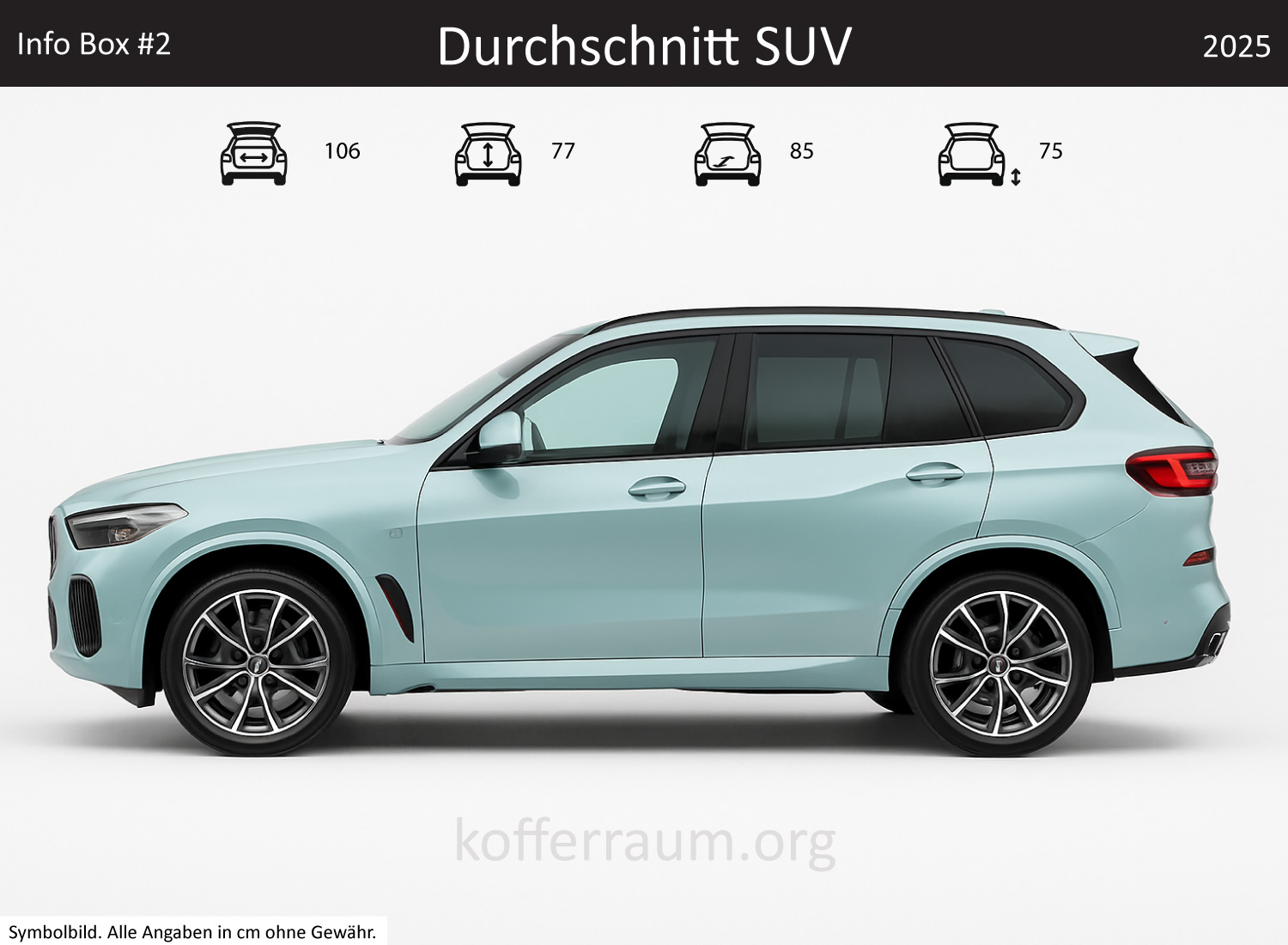
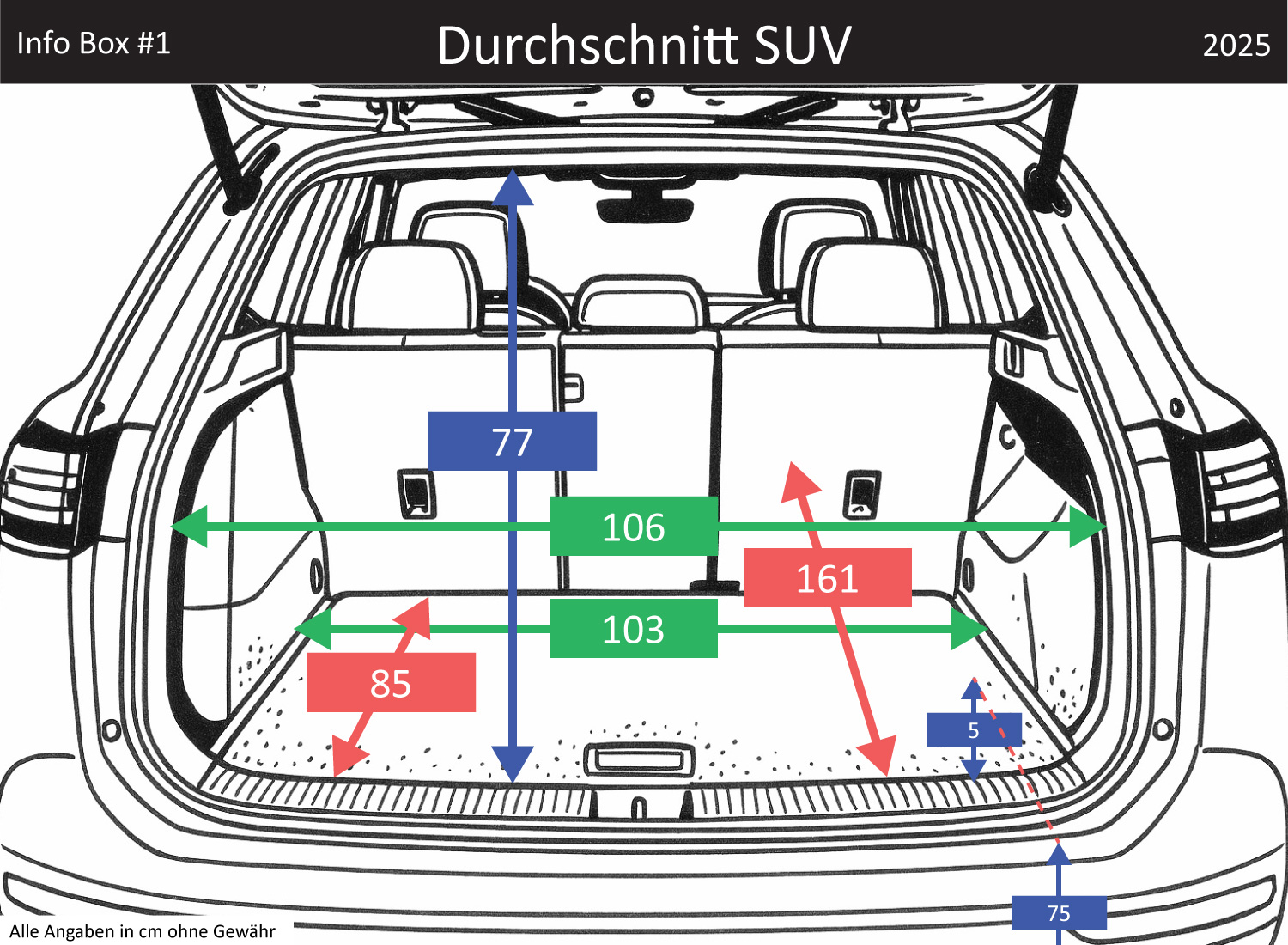
Average SUV Boot Dimensions in cm
Vehicle Type
The SUV (Sport Utility Vehicle) is a vehicle type that combines elements of off-roaders, estate cars and saloons. Characteristically, they offer a higher seating position, greater ground clearance and a tidy, often angular silhouette. SUVs come in various size classes — from the compact City SUV to the full-size large SUV — and they serve both private buyers and families. Technically, the range extends from front-wheel-drive, city-focused models to four-wheel-drive variants with reinforced suspension; many modern SUVs are based on passenger-car platforms (the crossover principle) and are geared more towards comfort and practicality than extreme off-road capability.
Variants
SUVs come in a range of variants that can significantly affect the boot space. Three-row SUVs (7-seaters) have considerably less load capacity in their normal configuration when the third row is in use than two-row models. Coupé SUVs with a steeper roofline reduce the usable height and therefore the loading capacity; at the same time they look sportier, but practicality is compromised. Electric SUVs may have a lower or split loading floor due to the battery-pack housing, which changes the usable loading area. There are also models with sliding rear seats, variable loading floors or optional spare wheels versus tyre repair kits — all of which lead to noticeable variations in boot dimensions.
Boot Space
Typical features of modern SUV boot spaces are a relatively high, wide opening, a generally uniform loading surface and variable loading heights. Volumes vary widely with class: compact SUVs are often in the region of about 350–550 litres with the rear seat up; mid-size models typically between 450–700 litres; large SUVs can offer 700 litres and more. With the rear seats folded, volume frequently rises to 1,200–2,000 litres, depending on the model and the measurement method. Common features include split-folding rear seats (e.g. 60/40 or 40/20/40), a flat loading floor after folding, variable loading floors, underfloor compartments, tie-down points and extendable loading edges or load-area covers. Electric tailgates, hands-free opening and optional load securing systems are available on many models. Boot access is influenced by loading height and sill height: tall SUVs make it easier to lift large items into the boot, but can make loading into the boot more difficult.
History
The evolution of the SUV boot space mirrors the general development of the type: early off-roaders offered large, rugged cargo areas but were uncomfortable and less suited to everyday practicality. With the shift to crossover SUVs and the maturity of comfort-oriented platforms, the interior has become increasingly user-friendly. In the 1990s and 2000s, demand grew for family-friendly, versatile cargo spaces, leading to modular seating and better space utilisation. More recently, weight reduction, safety systems and drivetrain concepts (hybrid/electric) are influencing interior design: battery packs can alter the underfloor, while intelligent upholstery and luggage solutions improve practicality. Overall, the focus has shifted from pure volume to flexible usability and ease of operation.
Classics
Among the exemplar, widely available SUV models that typify the segment are compact and mid-size contenders such as the Toyota RAV4, Honda CR‑V, Nissan Qashqai (called Rogue in some markets), Volkswagen Tiguan and Ford Kuga/Escape. In the premium and larger segment, BMW X3/X5 and Mercedes GLC/GLE are regarded as typical representatives, combining interior space with upscale equipment. These models illustrate the range: from practical boot spaces in compact crossovers to more generous loading solutions in mid-size and large SUVs.
More affordable models
Cheaper SUVs or affordable entry-level models are mainly found in the compact and subcompact crossover segments. Examples include the Dacia Duster (noted for good price/space ratio), Suzuki Vitara, Renault Captur, and base versions of the Hyundai Kona and Kia Stonic. These vehicles often offer a usable boot space for everyday use and holidays, but are equipped with more economical materials and trims. When comparing cheaper models, note that equipment packs, spare-wheel configurations and optional modular systems can significantly affect usable volume and practicality.
All information on this site is provided without warranty, and no liability is accepted for its accuracy or completeness.