
Nissan Ariya Boot Dimensions in cm
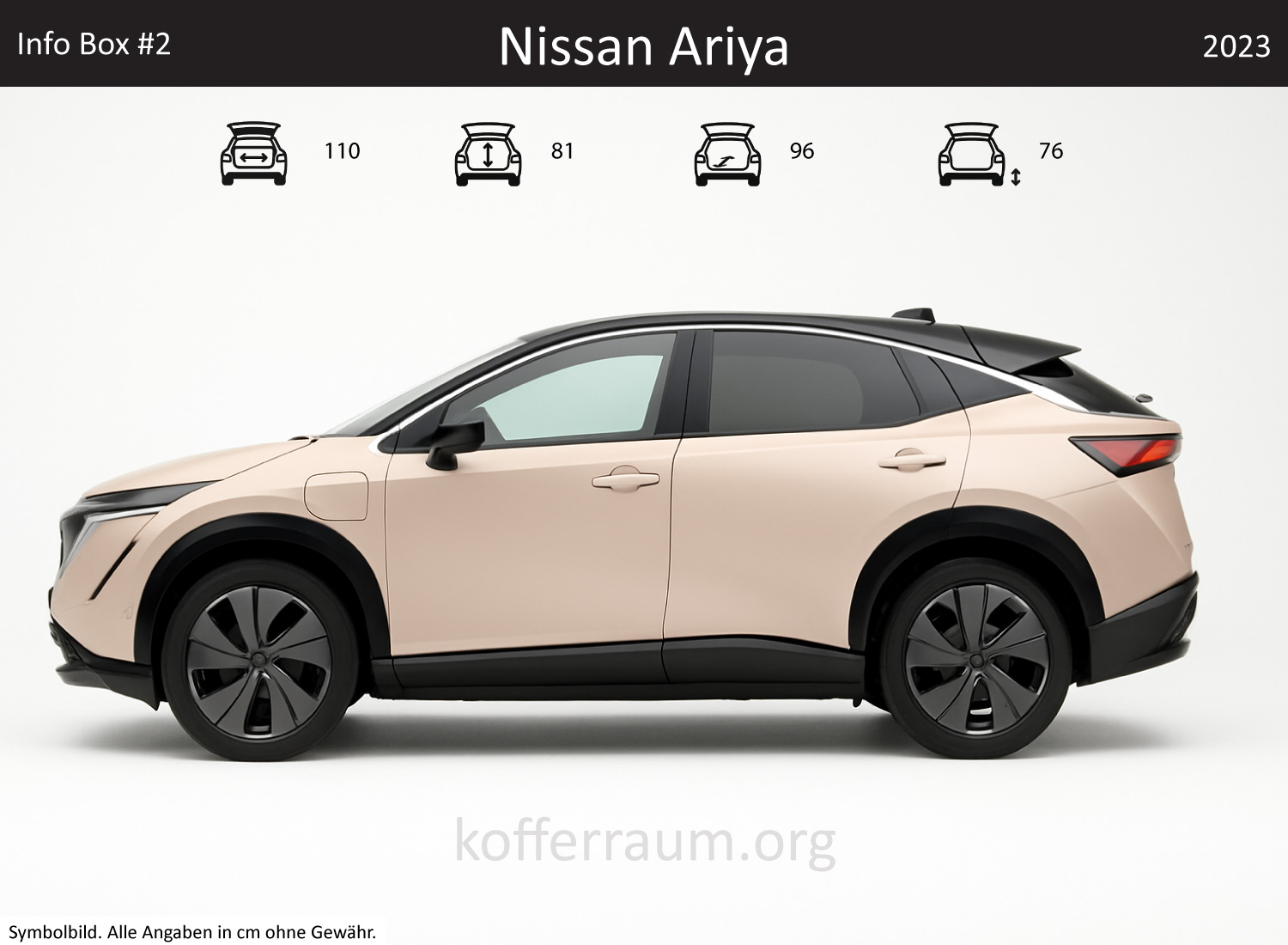
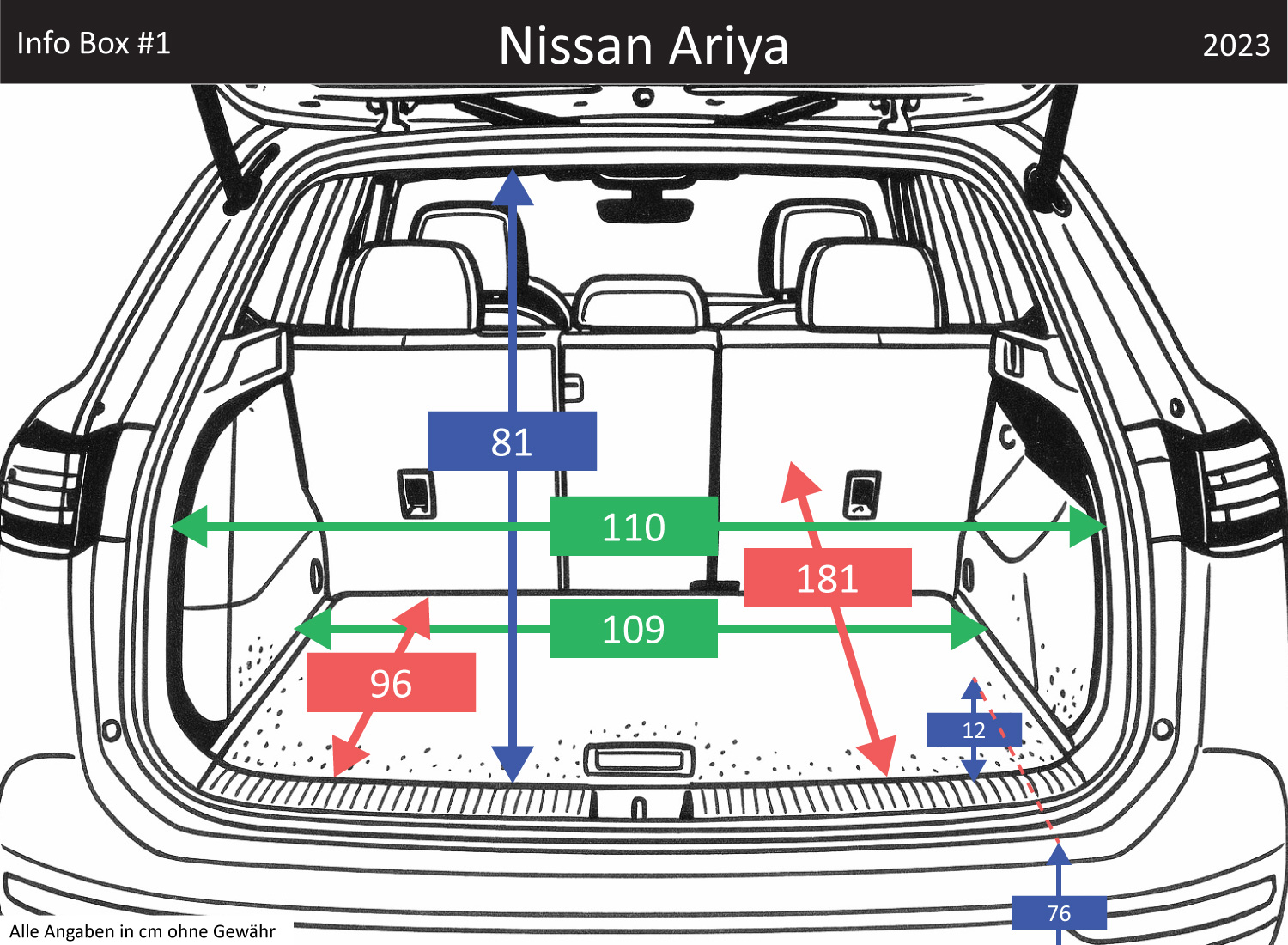
Model information
The Nissan Ariya is a fully electric SUV first unveiled in 2020. It combines modern design with innovative technology and offers a range of powertrain options, including various battery capacities and drive configurations. The Ariya forms part of Nissan’s strategy to advance electrification and offers a range of up to 500 kilometres, depending on the chosen variant. With a spacious interior and advanced safety features, the Ariya is aimed at environmentally conscious buyers who value comfort and performance.
Variants in the same range
The Nissan Ariya is offered in several variants, including different drive configurations such as front-wheel drive and all-wheel drive. There are also various trim levels that differ in terms of performance, range and equipment. These variants should not be confused with other Nissan models such as the Nissan Qashqai or the Nissan Juke, which occupy different vehicle segments.
Model year differences
The Nissan Ariya was introduced in 2020, and since then there have been no significant model changes affecting body dimensions or boot dimensions. Future model years could, however, bring changes to equipment or technology that could affect the functionality of the boot. Currently, the boot capacity remains constant, which is important for buyers who rely on a certain amount of storage.
Direct competitors
In the same price band and size, there are several comparable models, including the Volkswagen ID.4 and the Ford Mustang Mach-E. The Volkswagen ID.4 offers a boot capacity of around 543 litres, which makes it somewhat roomier than the Ariya. The Ford Mustang Mach-E has a boot capacity of around 402 litres, making it smaller than the Ariya. These differences in boot space can be decisive for buyers who place value on storage.
More affordable alternatives
More affordable alternatives to the Nissan Ariya with similar boot dimensions include the Kia e-Niro and the Hyundai Kona Electric. The Kia e-Niro offers a boot capacity of around 451 litres, while the Hyundai Kona Electric, at 361 litres, is somewhat smaller. These models are generally cheaper, but offer similar cargo space, which makes them attractive options for buyers on a tight budget.
All information on this site is provided without warranty, and no liability is accepted for its accuracy or completeness.